IT careers don’t always start with a technical degree or a perfectly planned roadmap. During Girls’ Day 2026, we opened up about our own journeys into tech and the lessons we learned along the way.
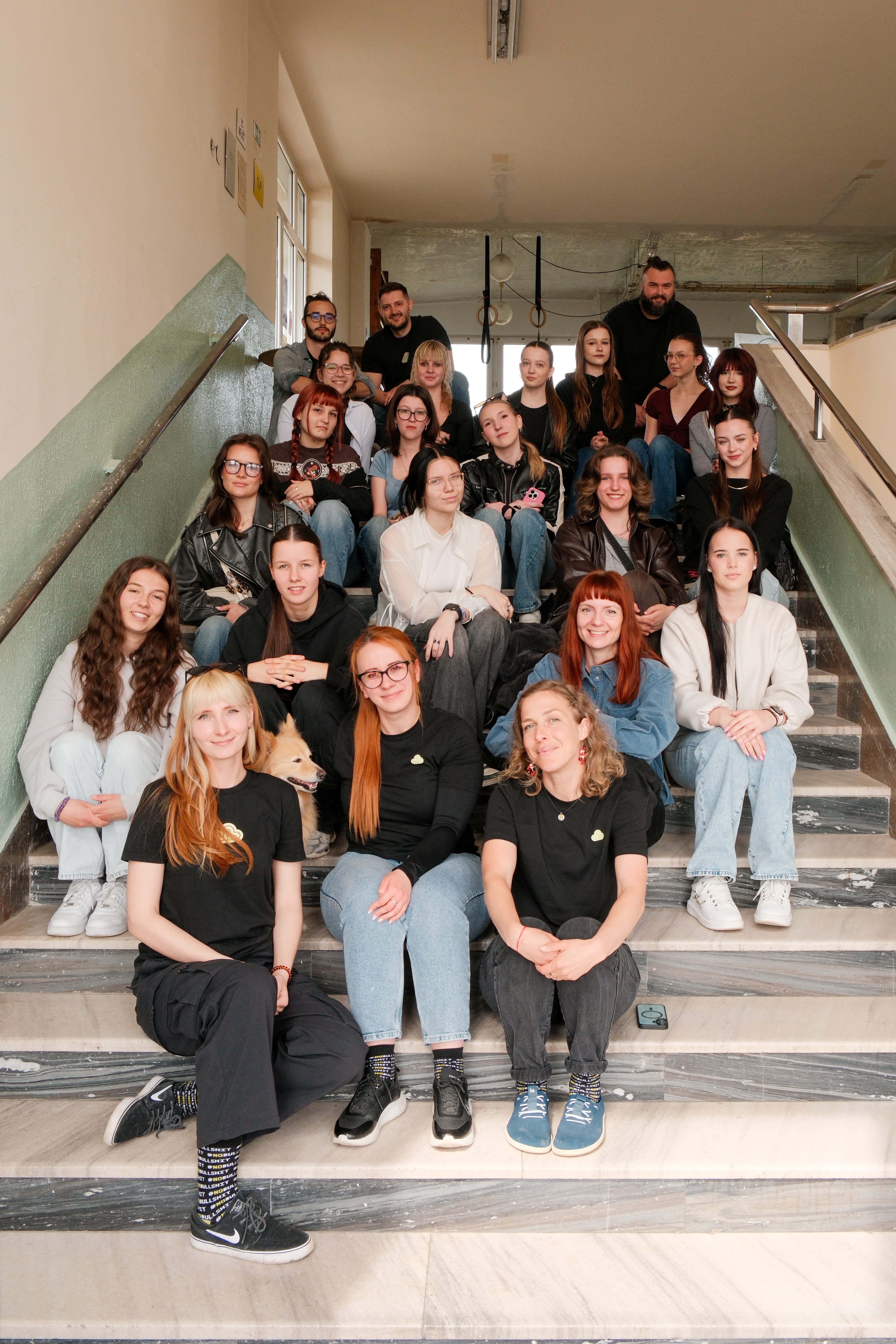
Despite the stereotypes that still linger around the industry, more women are building their careers in IT and not through one predefined path, but through curiosity, openness and a willingness to try something new. And that’s the message which we [hopefully] delivered to a group of ambitious high school girls at Girls’ Day 2026 by Aj Ty v IT.
This has been our second time in Labyrinth Labs that we’ve welcomed students from various Slovak high-schools, but this year we doubled our #LabLabs girls team. Laura, Eva, Zuzana and Zuzi shared that a career in tech is not limited to people with a technical degree. And that our journeys reflect a broader shift in how people enter and grow within the industry.
There Is No Single Way Into IT
What we shared during Girls’ Day is something we’ve all experienced firsthand. None of our journeys into IT followed a straight or expected path. None of us grew up with a single, clearly defined goal to work in technology. Instead, we each arrived here from different directions, often through decisions that didn’t feel that big at the time.
Laura, for example, came from a non-profit background where she discovered her interest in marketing, but it was only when an opportunity appeared in Labyrinth Labs that she decided to step into something new. As she puts it, “I thought, why not? I’ll try something new. I never would have imagined ending up in IT, but after almost four years, I know it was one of my best decisions.”
Zuzana’s path shows that entering IT does not mean leaving your original field behind. Her background in psychology naturally translated into working with people in a tech environment, where understanding behavior and supporting growth are essential. She describes it simply: “I realized what I actually enjoyed most was people and their behavior in the workplace… and I found out it’s not just about programming and computers, but about great people I can support and help grow in their careers.”
Eva’s journey has been more gradual, built step by step across different environments. “One of my first employers was an IT company, a system integrator. Later, I experienced the corporate world and licensed software in the local branch of a global IT giant. From there, I moved to a completely different environment, a hosting company’s server team, where I had to learn a lot on my own. And it’s been similar now at Labyrinth Labs,” she says, highlighting how growth in this field never really stops.
For Zuzi, the turning point came when she began to connect her work with the product itself. After exploring industries like finance and insurance, it was in tech where she found a stronger sense of meaning and direction. “I realized how much more interesting recruitment and marketing can be when tied to an innovative and modern product,” she explains.
Learning a New Language
We also spoke openly about the reality of starting without a technical background. Because while IT is accessible, it does require learning something completely new.
At the beginning, many things simply don’t make sense. Laura recalls that “for me, the cloud was just a place to store photos, Loki was a mythical creature and Raspberry Pi[e]… well it certainly looked more delicious in my head than a processor…” while Zuzana describes those early moments with humor: “whenever someone mentioned an IT term, I had Homer Simpson with cymbals in my head.” Zuzi shares a similar feeling from before she even joined, saying she “felt quite lost” despite knowing some of the basic concepts.
These moments are not exceptions, they are part of the process. Learning IT is not about knowing everything from day one, but about gradually building understanding and confidence.
We Don’t Grow Alone
One of the strongest messages we wanted to pass on is that growth in IT is not something you have to figure out by yourself.
Across all our stories, our team members played a key role. The environment we stepped into made it possible for us to learn, ask questions and improve without feeling out of place. What is more, even the tech people learned to look at their work from a different perspective, giving them a chance to step out of their comfort zone and learn to speak in more “non-tech friendly” terms.
As Zuzana explains, “my colleagues explained even the basics with incredible patience and never made me feel uncomfortable for asking… I learned not to be afraid to ask questions.” Laura shares a similar experience, describing how colleagues helped her navigate the space by sharing resources and taking the time to explain things until they made sense.
Zuzi adds another layer to that experience by highlighting how different perspectives helped her connect the dots. “We scheduled multiple meetings with different people who shared both technical and business perspectives… I listened, asked a lot of questions, and eventually everything connected.”

IT Is Broader Than It Looks
Another important realization we shared is that IT is far more diverse than it is often perceived. It is not limited to programming or purely technical roles.
Our own experiences reflect that. We work across sales, marketing, HR and operations, roles that are essential to how tech companies function and grow. What connects them is not code, but context, culture and collaboration.
Zuzana captures this shift in perspective well: “it’s not just about programming and computers, but about great people I can support and help grow.” Laura adds that creativity has a strong place in tech environments, especially when there is room to experiment and push boundaries.
At the same time, Eva highlights the broader impact of the work we do. “I’m constantly fascinated by how fundamentally technology impacts business, both positively and negatively. At Labyrinth Labs, by helping companies build reliable IT infrastructure, we contribute to their success,” she says, pointing to how closely technology is tied to real business outcomes.
Looking Ahead
When we talk about the future of women in IT, we see progress, but also space for further change. The number of women in tech is growing, and with it, the visibility of different career paths and role models.
At the same time, we share a common perspective that the goal is not to make women in tech a special topic, but a natural part of the industry. A space where diversity is expected, not highlighted as an exception.
Why We Shared This
Girls’ Day gave us the opportunity to step back and reflect on our own journeys, not as a set of instructions, but as real examples of how different those journeys can be. At the end of the day, we asked the girls what they thought about this format, especially since we [sadly] don’t have a purely technical role represented in our girl team yet.
Their response reassured us. They said it was interesting to listen to our stories and see how many different paths and possibilities exist within IT. Which means the message we wanted to deliver actually got through.
We didn’t want to present a perfect or linear story. We wanted to show that uncertainty, learning and change are all part of the process. And most importantly, that you don’t need to have everything figured out before you begin. Already looking forward to Girls’ Day 2027!